


That got me thinking: off-grid living should not mean giving up the normal routines that make a house feel like home. And using a hair dryer is a great example. If you use one at home as often as we do at my place, here are some numbers you may need to know:
Hair dryers are small enough to hold in one hand, but many draw between 1,600W and 2,300W while operating.
For comparison, current New Zealand models include a 1,600W Dyson Supersonic, a 1,800W Panasonic model and Philips models rated at 2,100W to 2,300W.
A 2,100W hair dryer running for:
- 5 minutes uses approximately 0.18kWh.
- 10 minutes uses approximately 0.35kWh.
- 15 minutes uses approximately 0.53kWh.
That may not sound enormous compared with a full battery bank. The bigger issue is how much power the appliance demands while it is operating.
Real life is never just one appliance.
A hair dryer may be drawing more than 2,000W, but the rest of the house does not stop.
While someone is getting ready in the morning:
- The fridge or freezer may start its compressor.
- The household water pump may switch on.
- Someone may boil the kettle.
- The toaster could be running.
- The washing machine may already be operating.
- Lights, internet and other background loads remain on.

Above: examples of household appliances with high start-up surge.
Suddenly, the inverter is not supplying one appliance. It is supporting several kilowatts of household demand, with some appliances creating a short but significant start-up surge.
This is where inverter quality and system design become extremely important.
The hair dryer is not actually the surge problem.
This is an important distinction.
A hair dryer is mainly a high continuous load. It does not normally have the same large start-up surge as a water pump, compressor, air conditioner, or power tool.
The challenge appears when the hair dryer is already using a large portion of the inverter’s capacity and another appliance suddenly starts.
A lightly built inverter may have enough power to run each appliance separately but struggle when normal household loads overlap.
A properly sized, low-frequency hybrid inverter provides more resilience for these real-life moments.
Why low-frequency hybrid inverters suit full-time off-grid homes.
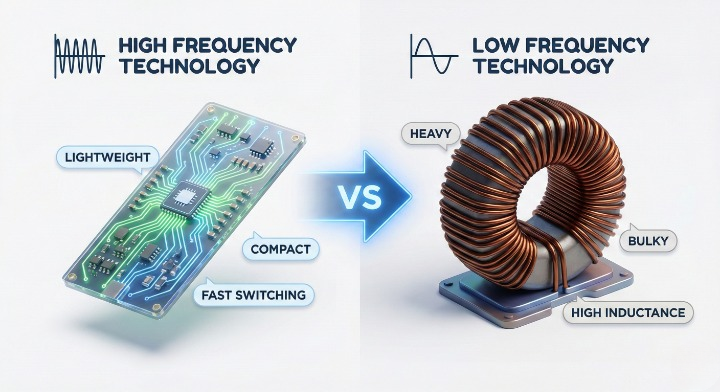
Low-frequency inverters use a substantial internal transformer. This makes them heavier and generally more expensive, but it also gives them excellent overload and surge-handling ability.
They are particularly well suited to homes running appliances such as:
- Water and wastewater pumps
- Fridges and freezers
- Air conditioners
- Microwaves and kitchen appliances
- Power tools and compressors
- Washing machines
- Hair dryers and other high-power personal-care appliances
The transformer helps the inverter absorb short bursts of demand from motor-driven appliances without being overwhelmed as easily.
For example, TBB describes its RiiO Sun II low-frequency inverter as providing 200% surge and 300% overload capability, specifically for powering demanding loads. GridFree’s transformer-based inverter range is selected with these real off-grid conditions in mind.
Can a high-frequency inverter run a hair dryer?
Yes. A correctly sized, good-quality high-frequency inverter can run a hair dryer.
But that is not the complete question. The better question is:
"Can it run the hair dryer while the rest of your off-grid home continues operating normally?"
High-frequency inverters can be suitable for weekend baches, mobile applications and lighter systems with predictable loads. They are compact, efficient and generally more affordable.
For a permanent off-grid home, however, loads are rarely predictable. Pumps start automatically. Appliances overlap. Guests arrive. Families grow. New appliances are added.
That is why GridFree generally recommends low-frequency, transformer-based hybrid inverters for serious, full-time off-grid living.
You can read the more technical explanation in our original guide:
Low-Frequency Hybrid Inverter vs High-Frequency Hybrid Inverter.
Off-grid living should still feel like normal living.
For many households, a hair dryer is not an unnecessary luxury. It is part of a night routine, getting ready for work, school, an event, or simply starting the day feeling comfortable.
The same applies to using a coffee machine, running a washing machine, cooking dinner or turning on a power tool.
Living off-grid may require you to understand your energy use, but it should not force you to constantly negotiate with your appliances.
You should not need to announce:
“Don’t use the kettle! I’m drying my hair.”
A properly designed system gives you enough capacity and resilience to live normally.
Don’t design your home around the bare minimum
When comparing off-grid solar systems, it is easy to focus on the number of panels or the size of the battery bank.
But the inverter is the heart of the system. Every appliance in your home depends on it.
Choosing the cheapest or lightest inverter may save money at the beginning, but it can also leave you managing appliances, avoiding overlapping loads, or planning an expensive upgrade later.
Do not compromise your off-grid lifestyle. Choose an inverter designed for real life.
When sizing your system, include the appliances that genuinely matter to your household. Even the hair dryer.
Keen to better understand what type of solar system works for you?
👉 Use the GridFree Off-Grid Solar Calculator to build a realistic load list.
👉 Or talk to our team about a system designed around your lifestyle.
Zed,
GridFree Co-founder.